

Indian jokes are a lively and fun part of humor that reflect everyday life, culture, and relatable situations across India. They often include playful conversations, family dynamics, school moments, and lighthearted takes on common experiences. These jokes are enjoyed for their simplicity, creativity, and ability to make people smile across different ages and backgrounds.
What makes Indian jokes especially entertaining is their connection to real-life situations and cultural quirks. From funny misunderstandings to clever wordplay, they bring people together through shared laughter. Whether shared among friends, family, or online, Indian jokes are a joyful way to lighten the mood and celebrate humor in everyday life.
Funny Indian Family Jokes
Indian family jokes are funny because every Indian family is simultaneously unique and exactly the same as every other Indian family in ways that require no explanation to anyone who grew up in one.
- Why does every Indian mother have eyes in the back of her head? Because she installed them when the first child learned to walk toward trouble.
- An Indian father said he was disappointed. His son got 98 percent. The father asked about the other 2 percent as if it had personally insulted the family name.
- Why do Indian aunties ask about marriage at every family gathering? Because they have finished all other topics and marriage is the one that never runs out of new angles to explore.
- An Indian mother said she was not going to interfere. She then interfered comprehensively and called it concern which is technically a different category of activity.
- Why does every Indian household have a living room that nobody lives in? Because it is reserved for guests and if the guests saw how the family actually lived there would be questions.
- An Indian dad gives two things freely — unsolicited advice and the WiFi password after twenty minutes of demonstration that you deserve it.
- Why do Indian grandmothers always have food ready at any hour? Because an unprepared grandmother is not a concept that Indian culture has ever formally recognized or accepted.
- An Indian mother asked her son how his exam went. He said fine. She asked five more questions and extracted the complete academic situation through a technique she had spent years refining.
- Why do Indian fathers turn off every light in the house? Because electricity costs money and money is not something that grows on the tree that also does not exist in the backyard for a reason.
- An Indian family had a quiet dinner. The next day everyone called to ask what was wrong because quiet meant something and someone needed to know what it was immediately.
- Why does every Indian home have a steel utensil collection that cannot be given away? Because grandmother bought it, mother maintained it, and throwing it out would require a family vote nobody would survive.
- An Indian uncle gave career advice for forty-five minutes. The advice was to become an engineer or doctor. The forty-five minutes was spent explaining why those were the only two options.
- Why do Indian parents say they sacrificed everything? Because they did and they want you to know they want you to know and they want to know that you know they want you to know.
- An Indian mother cleaned the house before the cleaning lady arrived because you cannot let a stranger see the house in its natural state without preparing the natural state first.
- Why do Indian families take so long to say goodbye at the door? Because the goodbye begins inside, continues at the door, restarts at the gate, and concludes at the car with final instructions.
| Indian Family Situation | What Was Said | What Was Meant |
| “Eat more” | You look thin | I love you |
| “Study hard” | Be an engineer | Make me proud |
| “We’ll see” | Probably no | Definitely no |
| “Your cousin got 99%” | Do better | Competition is motivation |
| “I’m not angry” | I am very angry | Prepare accordingly |
| “Just five minutes” | Unspecified time | This will take a while |
Indian Wedding Jokes
Indian weddings are not events — they are civilizations that arise, flourish, feed thousands, produce music, and conclude three days later leaving everyone exhausted, full, and somehow already planning the next one.
- Why do Indian weddings have five hundred guests minimum? Because the family alone is three hundred and the friends of the family are people and people were invited.
- An Indian wedding started two hours late. Everyone was surprised it was only two hours late and called it practically punctual for the circumstances.
- Why does the Indian groom arrive on a horse? Because arriving in a car would be insufficiently dramatic for an occasion that requires drama proportional to the number of guests attending.
- An Indian bride’s outfit weighs more than some furniture. She carries it gracefully because she has been training for this specific moment since she was approximately seven years old.
- Why do Indian weddings have so many ceremonies? Because each one was added by someone with authority and removing any one of them would require authority that nobody currently possesses.
- An Indian wedding DJ played the same five Bollywood songs for six hours. Everyone danced the same way every time and called it a different song because the mood was slightly different.
- Why do Indian mothers cry at weddings? Because they are happy, sad, proud, worried, and calculating the cost of the next wedding all at the same time and tears process all of this efficiently.
- An Indian father of the bride smiled throughout the entire wedding. He was also calculating the total expenditure throughout the entire wedding and those two activities can coexist in the same face.
- Why does the Indian wedding menu have forty-seven dishes? Because the guests are judging comprehensively and a menu that could be counted easily suggests insufficient hospitality effort.
- An Indian wedding photographer took four thousand photos. Three were selected. The other three thousand nine hundred and ninety-seven were stored on a hard drive for a day that never arrives.
- Why do Indian wedding invitations arrive three months early? Because the date needs to be clear before it conflicts with eleven other weddings already scheduled in the same social circle.
- An Indian wedding guest brought a gift, ate four complete meals, danced at both the sangeet and the reception, gave four blessings, and called the weekend restful compared to last month.
- Why do Indian weddings have a mehendi ceremony? Because any occasion that allows women to sit together for hours with music and designs while men figure out logistics is a ceremony worth keeping.
- An Indian groom’s side and bride’s side sat across from each other at the wedding. They eyed each other’s outfits with the competitive appreciation of two teams who have both prepared extensively.
- Why does the baraat procession move so slowly? Because you cannot rush tradition, the music requires space to breathe, and the horse has its own pace and the horse is technically in charge.
Indian Food Jokes
Indian food jokes are easy to write and impossible to finish because Indian food has approximately four hundred regional variations and each region believes their variation is the one that actually counts.
- Why do Indians put spice in everything? Because food without spice is technically just a texture and texture alone does not constitute a complete meal by any standard recognized in the subcontinent.
- An Indian mother made food for six. Fourteen people arrived. There was still food left over. This was not magic it was planning and the planning was called a normal Tuesday in her experience.
- Why do Indians sneak their own food into movie theaters? Because the snacks available are fine but fine is not the standard that a family who packed food from home is willing to accept.
- An Indian man went to a non-Indian restaurant. He ordered the spiciest thing available. The waiter said it was very spicy. He added hot sauce and said now it was getting somewhere closer.
- Why does every Indian kitchen smell the same? Because the onion, garlic, ginger combination that starts every dish is the signature fragrance of the entire culinary tradition entering its primary phase.
- An Indian grandmother’s recipe said add salt to taste. The taste she referred to had been calibrated over seventy years and could not be reproduced by someone who had calibrated theirs for fewer.
- Why do Indians eat rice at every meal? Because rice is the foundation upon which the meal stands and a foundation cannot be optional regardless of current dietary trends suggesting otherwise.
- An Indian man said he was not hungry. His mother interpreted this as not yet hungry and began preparing food to be ready when he arrived at the correct conclusion which she anticipated shortly.
- Why does Indian street food taste better outside? Because the open air, the speed, the noise, and the slight uncertainty about the logistics are all ingredients that a kitchen cannot replicate indoors.
- An Indian family went to an Indian restaurant abroad. They said it was good but not like home. This was the highest compliment the restaurant would receive and it was delivered as a gentle criticism.
- Why does every Indian household have a pressure cooker that sounds like a small emergency? Because urgency in the kitchen produces results that patience alone has not consistently delivered in time.
- An Indian cook never uses measuring spoons. She uses her hands, her eyes, her instinct, and sixty years of practice and the results are more consistent than any measuring instrument could achieve.
- Why do Indians add tadka to everything? Because the final tempering of oil and spice is the moment a dish becomes itself and before that moment it is merely a collection of ingredients with potential.
- An Indian student abroad tried to cook dal. He called his mother. She described it without measurements. He called again. She said you will know when it looks right and he understood this eventually.
- Why is Indian chai so important in the morning? Because the morning without chai is a morning that has not yet fully committed to being a morning and commitment is what the day requires first.
Indian Bollywood Jokes
Bollywood has given India a shared language of drama, music, rain, slow motion, and the understanding that any problem can be resolved through a well-timed song if the choreography is sufficiently synchronized.
- Why do Bollywood heroes never get wet in the rain? Because the rain only falls on them when the song requires it and the song requires it only when it is emotionally the right moment.
- An Indian man watched a Bollywood movie and cried four times. He said he was not crying he had something in his eye each time and the something arrived precisely at the emotional peak.
- Why do Bollywood fight scenes involve exactly one hero defeating forty villains? Because the physics of emotion override the physics of bodies and enough righteousness makes the numbers irrelevant.
- An Indian grandmother watched a Bollywood movie and narrated the entire plot in advance because she had seen enough to recognize the formula from the opening scene onward.
- Why does every Bollywood hero have a love interest who hates him initially? Because the arc from hate to love is the most satisfying arc and Indian cinema has always understood what the audience came for.
- An Indian family watches Bollywood films and cries at the sad parts even when they have seen it seven times because the seventh time is when you cry the most knowing what is coming.
- Why do Bollywood songs have dancers appearing from nowhere? Because if the hero is feeling it then the environment feels it too and the environment’s feeling takes the form of synchronized movement.
- An Indian man described his life like a Bollywood plot. His friend said that was very dramatic. He said no it was only partly dramatic and the rest was waiting for the dramatic parts to arrive.
- Why do Bollywood villains always explain their plan? Because the explanation is where they reveal their intelligence before it fails and failing without the explanation would be considerably less satisfying for everyone.
- An Indian student wrote a Bollywood plot summary for an English class. The teacher said it needed simplification. The student said it was already simplified and the original had three more subplots.
- Why do Bollywood heroes and heroines run toward each other in slow motion? Because running at normal speed does not adequately communicate the distance the relationship has traveled to reach this point.
- An Indian grandmother said new Bollywood films were not as good as old ones. She then watched a new one and cried twice and called it adequate while watching it again the following evening.
- Why does every Bollywood film have a comedy friend for the hero? Because the comedy friend maintains the emotional temperature of the film at a level that allows the drama to be fully dramatic.
- An Indian couple had their first dance at their wedding to a Bollywood song from 1995. Everyone cried. Everyone knew all the words. Everyone agreed that was the correct song for the occasion.
- Why do Bollywood remakes always do well? Because the original was already a perfect emotional delivery system and people want the delivery system again with updated production values and the same feeling.
Indian Cricket Jokes
Cricket in India is not a sport — it is a national religion with two billion devotees, specific prayer schedules aligned with match times, and the belief that certain individuals can physically affect the outcome through ritual behavior at home.
- Why do Indian offices go quiet during a World Cup match? Because productivity is a daily commitment and cricket is a once-in-a-generation opportunity and the priorities are clearly ordered.
- An Indian man said he was casually watching cricket. He was wearing lucky clothing, had not eaten since the last wicket fell, and had not sat down in forty-five minutes and was not planning to.
- Why do Indian cricket fans blame the commentators? Because someone must be blamed and the players are too beloved and the commentators said something optimistic right before things went wrong.
- An Indian grandmother watched cricket and said the bowler had a bad energy about him. She was subsequently proven correct and was not surprised because she had been watching since 1983.
- Why do Indians know the batting average of every player including the third substitute? Because cricket statistics are not numbers they are personality descriptions and every Indian is a student of personality.
- An Indian man watched India lose and said he was fine. His family watched him be fine for twenty minutes and then gave him food and distance because fine had a specific face they recognized.
- Why do Indian fans travel internationally to watch cricket? Because watching at home alone does not generate enough collective energy to influence the outcome and collective energy is considered a real factor.
- An Indian child was asked his dream. He said to play for India. His mother said study first. His coach said practice first. His father said score first. Everyone was technically correct and unhelpful.
- Why do Indian cricket matches feel like national events? Because when one hundred and forty billion people share a feeling simultaneously the feeling becomes the national weather rather than personal emotion.
- An Indian family divided itself by cricketing opinion at dinner. The food was excellent. The conversation was louder. Both things continued for three hours and the food ran out before the opinions did.
| Indian Cricket Scenario | Fan Reaction |
| India wins by 1 run | National celebration for three days |
| India loses by 1 run | National mourning, analysis for two weeks |
| Rohit hits six | Every TV in the neighborhood goes up in volume |
| Dropped catch | The catcher’s name becomes part of the language |
| Rain stops play | Everyone blames the weather forecaster personally |
| DRS overturns decision | Trust in technology restored, briefly |
Indian Traffic and Road Jokes
Indian traffic operates on a system so complex and so efficient in its apparent chaos that transportation engineers from other countries study it and conclude that it works because of a social contract that exists entirely outside the legal framework.
- Why do Indian drivers honk even when nobody is in front of them? Because the horn is not only for obstacles it is for announcing your presence, your intention, your mood, and your position on life.
- An Indian road has four lanes painted and eleven lanes operating because the paint is advisory and Indian drivers treat advice as information to be weighed against personal judgment.
- Why do Indian auto-rickshaws take the longest route? Because the driver knows the city better than the GPS and the route he takes has its own logic that reveals itself at the destination.
- An Indian pedestrian crossed the highway with complete calm. A foreigner called it brave. The pedestrian called it Tuesday and resumed crossing without acknowledging the philosophical difference.
- Why do Indian buses never fully stop? Because fully stopping creates a gap between the expected speed and the actual speed that takes too long to close and time is traffic and traffic is everything.
- An Indian family road trip begins with packing for three hours and arguing about who sits where for forty-five minutes before the car starts and the actual journey begins its second hour on the driveway.
- Why do Indian traffic signals feel optional? Because they suggest a sequence and suggestions are processed through judgment and judgment sometimes concludes that the sequence applies to other vehicles.
- An Indian driver in a new city used GPS and also asked twelve people for directions and the GPS was wrong and one of the twelve people was right and the driver knew which one before they answered.
- Why do Indian roads have speed bumps every fifty meters? Because speed limits were tried and then speed bumps were installed to provide a physical rather than philosophical argument for reducing speed.
- An Indian car horn has four volumes: greeting, warning, frustration, and philosophical disagreement with urban planning decisions made by someone who clearly never drove in this specific city.
Indian Jugaad and Innovation Jokes

Jugaad is the Indian art of fixing something with whatever is available, making it work better than the original, and never explaining the solution to anyone because the explanation would raise more questions than the problem.
- An Indian engineer fixed a machine with a pen, a rubber band, and a prayer. The machine worked better than it had when it was new and nobody asked how because the how was not the point.
- Why do Indians fix everything with tape? Because tape is the jugaad foundation upon which more creative jugaad solutions are built when tape alone proves insufficient for the scope of the problem.
- An Indian household has a broken thing that works perfectly. The family has been planning to fix it for six years. The plan continues. The thing continues working. Both situations coexist peacefully.
- Why do Indian programmers comment their code so minimally? Because the code explains itself and if it does not explain itself then the problem is that you are reading it instead of trusting it.
- An Indian man fixed his wifi router by restarting it, talking to it, and placing it in a slightly different position. He does not know which action worked and is not interested in finding out scientifically.
- Why do Indians use one hand to hold a phone and simultaneously do seven other things? Because two hands were provided but one hand does most things adequately and the other hand is available for jugaad.
- An Indian innovator created a solution that solved three problems simultaneously. When asked how he said it was obvious once you stopped thinking about the problems separately and together.
- Why does Indian jugaad always involve string? Because string connects things, holds things, and provides the structural element that the original design apparently forgot to include when it was first built.
- An Indian mechanic diagnosed a car by listening to it. He was correct. He then fixed it with a part from a completely different model. The car worked. He shrugged and said the car understood.
- Why do Indian homes have things that technically should not work but do? Because the relationship between the person and the thing has been established over years and the thing cooperates accordingly.
Indian Festival and Religion Jokes
Indian festivals are scheduled so frequently that the country essentially operates on a calendar of upcoming celebrations with brief intervals of ordinary days scheduled between the important ones.
- Why do Indians celebrate so many festivals? Because there are enough deities, seasons, harvests, historical events, and regional traditions to fill a calendar and then add a second calendar just in case.
- An Indian family argued about Diwali decoration placement for three hours. The decorations were beautiful. The argument was also beautiful in its thoroughness and commitment to getting it exactly right.
- Why do Indian festivals always involve food? Because every important occasion deserves an important meal and no occasion has been deemed important enough to proceed without one in recorded Indian history.
- An Indian mother made three hundred sweets for Diwali and then said there was nothing in the house because nothing meant nothing new and everything counted as still existing from before.
- Why does Holi turn every white shirt into a modern art piece? Because Holi is the festival where restrictions dissolve and the shirt is included in the dissolution whether it agreed or not.
- An Indian uncle explained the religious significance of every festival in detail. His children listened. His grandchildren pretended to listen. His great-grandchildren were already at the food.
- Why do Indian temples have long queues? Because the deity is popular and popularity in religion as in everything else means waiting proportional to the demand for the limited supply of divine attention.
- An Indian grandmother performed a puja that lasted three hours. She described it as a quick one. The full version was reserved for occasions that required correspondingly full spiritual investment.
- Why does Navratri have people dancing for nine nights? Because nine nights of garba establishes the stamina of the community and also establishes which families have invested in the best outfits this year.
- An Indian man said he was not religious but visited the temple before every exam, job interview, and cricket match and explained that this was cultural and not religious and the temple did not clarify.
Indian Education Jokes
Indian education produces some of the world’s most capable engineers and doctors through a system that treats childhood as a preparation period for the examination that determines whether the childhood was used correctly.
- Why do Indian students know the periodic table perfectly? Because their parents told them the periodic table was the table everyone sat at and the seating arrangement was determined by how much of it you knew.
- An Indian parent received the school report and went straight to the marks without reading the teacher’s qualitative comments because numbers are the language that requires no interpretation.
- Why do Indian coaching centers open at 5am? Because the student who arrives first has already demonstrated a commitment level that the entrance exam is designed to reward and preparation begins immediately.
- An Indian student ranked second in class. His family said well done. The subtext said first would have been better and the subtext required no speaking because it was already universally understood.
- Why do Indian students carry such heavy school bags? Because the bag contains every book for every subject for every day of the week because leaving a book at home has consequences that outweigh the back pain.
- An Indian teacher asked who was not prepared. One student raised a hand. The teacher thanked the honesty and then began the lesson with that student facing the class as a learning tool.
- Why do Indian parents know everything about their child’s school? Because they attended orientation, joined the parent group, speak to three other parents daily, and have opinions about the homework policy.
- An Indian student finished his exams. His mother asked how they went. He said fine. She said fine means something went wrong and he spent twenty minutes clarifying that fine actually meant acceptable.
- Why do Indian students choose engineering? Because the question of what else to study requires more information than is available to a seventeen-year-old and engineering contains information about everything theoretically.
- An Indian child came home with a trophy. His father said where is the one for first place. His mother said wonderful darling. The child learned two things from this that he carried into adult life.
Indian Tech Industry Jokes

The Indian tech industry has produced some of the world’s most significant technology leaders through a combination of education pressure, natural aptitude, and the complete inability to accept that something cannot be done differently and better.
- Why do Indian engineers send emails at 2am? Because the problem presented itself at 2am and the problem did not check the time before presenting itself and neither did the engineer who loves the problem.
- An Indian programmer fixed the bug at 11:58pm before the midnight deadline. He told no one because the fix being done was the achievement and the credit was the fix working and not the acknowledgment.
- Why do Indian tech interviews have seven rounds? Because each round was added by someone who had a concern and nobody had the authority to remove any round once a concern had been formally expressed.
- An Indian software engineer commented his code with explanations so thorough that the comments were longer than the code and the comments would have been a better product than the actual code.
- Why do Indian developers always optimize for efficiency? Because wasting computational resources is like wasting food and neither is something that an Indian upbringing permits as a casual lifestyle choice.
- An Indian tech company had a meeting about the meeting schedule and scheduled a follow-up meeting to discuss the outcomes of the meeting about the meeting schedule and called this agile methodology.
- Why do Indians dominate the IT industry globally? Because a generation raised on the belief that precision, hard work, and problem-solving are moral qualities produces people who take those qualities to every room they enter.
- An Indian manager said the deadline was flexible. His team did not believe this and worked as if the deadline was absolute and delivered three days early just to account for the flexibility being withdrawn.
- Why do Indian engineers always have a backup solution? Because the primary solution was designed by a person who had already planned for the possibility that the primary solution was the backup for the real primary.
- An Indian developer said he would fix something in five minutes. He fixed it in fifty minutes and called it five minutes because the actual fix took five minutes and the rest was investigation which was separate.
Indian Monsoon Jokes
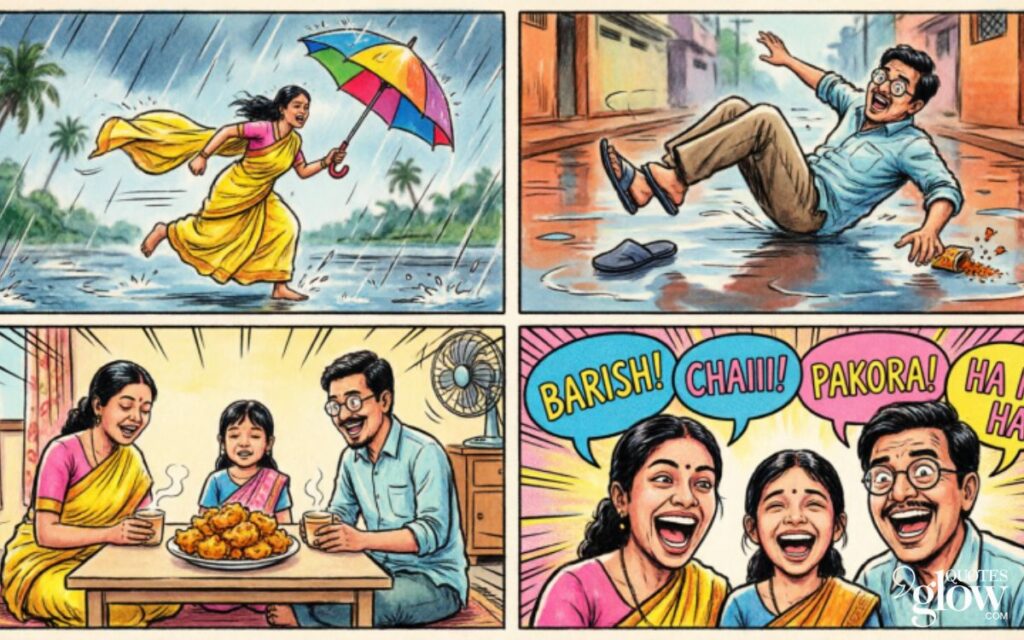
The Indian monsoon is not merely weather — it is a season, a cultural event, a relief, a disruption, a creative force, and the reason that every Indian drainage system is considered an optimistic work of fiction.
- Why do Indians love the first rain of monsoon? Because the first rain smells like everything the summer asked them to be patient about and patience that long deserves a reward that dramatic.
- An Indian city flooded for the third consecutive year. The municipal corporation said they were looking into it. The residents said they were also looking into it from their submerged ground floors.
- Why do Indians eat pakoras during monsoon? Because rain creates the specific emotional state that only fried food can address and the connection between weather and food in India is not coincidental.
- An Indian weather forecast said light showers. The light showers required a boat for the commute and the forecast was updated to say the previous forecast was optimistic about the nature of the showers.
- Why do Indian umbrellas always break on the first day of use? Because the first day is the day they are tested by conditions they were designed for and the design did not fully anticipate the actual conditions.
- An Indian man stepped out without an umbrella because the sky looked clear. The sky immediately reconsidered its position and provided proof that Indian skies have opinions about optimism without preparation.
- Why do Indian children love monsoon? Because puddles were not designed for avoiding they were designed for exactly what Indian children do with them and the adults’ reactions are part of the experience.
- An Indian office building’s parking lot became a lake. The employees took photos, shared them, discussed them, and then arrived late while describing the lake to the same colleagues who had sent the same photos.
- Why do Indian trains delay during monsoon? Because the monsoon is not on the train schedule and the schedule was written before someone consulted the monsoon about its own plans for the affected dates.
- An Indian grandmother said she knew when monsoon was coming. She was accurate for sixty-three years. The meteorological department was accurate for fewer and consulted her more than they publicly acknowledged.
Indian Humor Self-Aware Jokes
- Indians invented zero and then immediately applied it to the concept of free time for engineering students which is the most sophisticated application of zero in the entire mathematical tradition.
- Why is Indian humor so self-aware? Because a civilization that has seen everything and survived most of it develops a relationship with its own contradictions that can only be processed through laughter.
- An Indian explained his country in one sentence and needed forty-five minutes because one sentence was insufficient for the geographic, cultural, linguistic, and spiritual scope of the subject.
- Why do Indians find everything funny about India? Because the distance between what India intends and what actually happens is exactly the distance where humor lives and the distance is very well maintained.
- An Indian man said India was complicated. His friend said yes. They both laughed because complicated was the understatement and they both knew it and the knowing made the laughing louder.
- Why do Indians make the best self-deprecating jokes? Because self-deprecation requires both love for the subject and clear-eyed observation of the subject and Indians have both in abundant supply for their country.
- An Indian comedian told jokes about Indian parents. Every Indian parent in the audience laughed except the ones who recognized themselves and then laughed slightly later after brief reflection.
- Why do Indian memes travel so fast? Because shared experience that is precisely named travels at the speed of recognition and recognition among Indians who share the same upbringing is immediate.
- An Indian described the traffic to someone who had not been there. The description was accurate. The person did not believe it was possible. The Indian said I know and somehow that says everything.
- Why is Indian family humor universal? Because families everywhere share the same dynamics and Indian families simply perform those dynamics at a volume and scale that makes them easier for everyone to identify.
Indian Jokes One Liners
- My Indian mother’s recipe says add salt to taste and the taste she means has been calibrating since 1967.
- Indian five minutes is the measurement of time between a question and the answer that was already decided.
- An Indian parent’s favorite number is 100 percent and their least favorite is 99 because it represents an unaddressed gap.
- My dad’s WiFi password is 26 characters and includes our family history and a question I still cannot answer.
- Indian aunty radar activates the moment you are single at any gathering regardless of size, location, or stated purpose.
- An Indian grandmother’s kitchen contains ingredients from three decades and she knows exactly where every single one is without looking.
- Indian traffic is not chaos it is a negotiation and everyone on the road is negotiating simultaneously and winning.
- My Indian mother asked if I ate and then told me what I should have eaten before I finished answering the first question.
- An Indian engineer fixes problems before they happen and then explains afterward that the problem never existed which is technically accurate.
- Indian time has two speeds: very early for airport and flights, and philosophical for everything else that was specified with a clock.
- An Indian wedding guest attends for two days, eats for three, and talks about it for four months and this is called attending a wedding.
- My Indian dad said we were almost there when we were two hours from there and the almost was doing significant cartographic work.
- Indian student motivation is directly correlated to the social consequences of the grade and the social consequences are always significant.
- An Indian mother’s I am not angry is the beginning of a conversation about something far more specific than general anger.
- Indian jugaad operates on the principle that the solution exists before the methodology of finding it has been formally established.
Indian Jokes for Adults
- An Indian couple argued about directions. He was wrong for twenty minutes before she was right and they arrived on time because she had factored in his twenty minutes when she planned the departure.
- Why do Indian men avoid housework? Because the first time they did it wrong it stopped being their responsibility and the first time was specifically designed to achieve that outcome efficiently.
- An Indian man said he helped with cooking. He boiled water. He reported this as cooking. His wife updated the definition of helping to include specifics that would prevent future ambiguity.
- Why do Indian in-laws visit for three months? Because two months would be cutting the visit short and four months would be staying long and three months is just being family which has no prescribed length.
- An Indian couple’s first argument as married people was about the correct way to make chai. They are still married. The chai argument has never been formally resolved and is revisited seasonally.
- Why do Indian men call their wives at every store to confirm a purchase? Because independent purchasing decisions in a shared household require confirmation and confirmation prevents the specific conversation that follows unconfirmed decisions.
- An Indian woman said she was fine. The specific tone of fine communicated the complete situation more accurately than a detailed explanation would have and her husband understood immediately after eleven years.
- Why do Indian adults never fully leave their parents’ house even when they live elsewhere? Because the parents’ house is still the place where food appears without asking, opinions are given without requesting, and love is expressed through both.
- An Indian man’s bachelor party was organized by his mother who included his uncles, his cousins, and a brief prayer before the activities which were also supervised by an uncle who was very responsible.
- Why do Indian couples plan everything together? Because unilateral decisions in an Indian household carry consequences that require significantly more energy to manage than the original decision required to make.
Indian Jokes for Friends
- An Indian friend group has seven people and four of them are engineers and the other three are asked why they are not engineers at every reunion until they explain it more convincingly.
- Why do Indian friends always share food? Because the concept of eating in front of someone without offering is a social crime that Indian upbringing made permanent and non-negotiable.
- An Indian friend gives advice without being asked. This is called being a good friend. The advice is usually correct. The timing is always immediate regardless of whether the problem was recent.
- Why do Indian friends compete with each other? Because competition is love expressed through standards and if someone expected more from you they believed you were capable of more and that is affection.
- An Indian friend group planned a trip for six months. The trip was two days. The planning was the activity and the trip was the documentation of the planning outcome and both were equally valued.
- Why do Indian friends call at bad times? Because good times do not produce the same frequency of feeling that requires a phone call and bad times are when the friendship is most actively deployed.
- An Indian friend said I told you so with complete compassion and the accuracy was the kindness because now the solution could begin from an honest starting point.
- Why do Indian friends know everything about each other’s family? Because in Indian friendship the family is part of the package and understanding the package is required for understanding the person.
- An Indian friend group chat never sleeps because someone is awake in every time zone and something is always happening and the group exists to be informed immediately when things happen.
- Why do Indian friends always recommend doctors, lawyers, and accountants from within the community? Because a professional trusted by someone you trust is a professional with a reference that matters more than a rating.
Indian Jokes for Kids
- Why did the Indian kid bring food to school? Because his mother packed enough for the class and the teacher and the teacher’s family and the spare was for emergencies.
- An Indian child was asked what his father did. He said his father was an engineer. He was then asked what kind. He said the kind that fixes everything including things that were not broken.
- Why do Indian kids always do homework first? Because the alternative is explaining to mother why it was not first and the explanation takes longer than the homework and is less satisfying for everyone.
- An Indian child watched cricket with his grandfather. The grandfather explained every rule. The child knew all the rules already but listening was part of the experience and the experience was the point.
- Why do Indian kids know so many stories? Because Indian grandparents have been telling stories since the grandchildren could understand them and the stories carry everything that the family needs the children to know.
- An Indian child visited the temple and asked many questions. His grandmother answered every one. His questions were good. Her answers were better. He asked more questions to get more answers.
- Why do Indian kids love Diwali? Because Diwali means lights, sweets, new clothes, fireworks, and staying up late with the adults who are too festive to enforce the regular schedule.
- An Indian child helped his mother cook. He was assigned one task. He completed it with intensity and precision because tasks in an Indian kitchen are taken seriously regardless of the task’s technical complexity.
- Why do Indian kids memorize everything? Because the teacher said it was important and what the teacher said was important the parents confirmed was important and three layers of importance is impossible to ignore.
- An Indian child asked his grandfather how old he was. The grandfather said very old. The child said how old. The grandfather said old enough to know that that question has many better answers than a number.
Old Indian Jokes
- A classic Indian joke: a man asked God for wisdom. God asked how he wanted to receive it. The man said quickly. God laughed and said that is why you need it and began the long version.
- An old Indian saying: the guest arrives and the fish smells on the third day. They are both there. You manage both with the same grace and the grace is the actual skill being demonstrated.
- Why did the old Indian farmer say his land was his bank? Because the land does not close on holidays, does not charge fees, and does not go anywhere when the economic situation becomes complicated.
- An old Indian teacher said the student who asks the most questions will learn the most and then give the most answers later and the student who never asks will remain precisely as he started.
- Why do old Indian jokes still work? Because old Indian jokes are about old Indian truths and old Indian truths have not been updated by the circumstances that old Indian truths created in the first place.
- An old Indian proverb says the man who says he knows everything has never sat with the man who does. The man who does say nothing and is found by the people who need the silence explained.
- Why did the old Indian grandfather say less as he got older? Because he learned that every word he said became advice and advice is only useful when the person receiving it is ready and timing matters.
- An old Indian joke: two friends argued about who was more stubborn. They argued for forty years. Neither changed their position. They concluded it was a tie and this was the only thing they ever agreed on.
- Why do old Indian jokes always have a moral? Because the joke was the delivery system and the moral was the content and in old India you did not deliver something without including the content it was meant to carry.
- An old Indian grandfather said he had no regrets. He then listed seventeen things he would have done differently. He said those were observations not regrets and the distinction was important to him personally.
Indian Jokes One Liners in English
- Indian GPS says turn left in 200 meters and the driver turns left based on his grandmother’s advice from 1998 which was also technically accurate for that specific road.
- My Indian mom’s cooking measurement system is ancient and precise and entirely unavailable in written form and cannot be transferred through any currently available educational technology.
- Indian traffic lights have three colors and Indian drivers have developed seventeen responses to those three colors depending on time of day, lane position, and personal philosophical alignment.
- An Indian student’s study schedule is very organized on paper and very aspirational in practice and both versions are shown to different people depending on the question being asked.
- Indian wedding guest math: invite 300, cook for 500, argue about whether 600 would have been safer, conclude 700 was the correct number when the food runs low which it does not.
- My Indian father said he was young once. This was presented as cautionary information about the temporary nature of current conditions and as a warning about the permanent nature of its consequences.
- Indian phone battery always dies at the most important moment because importance attracts attention from all things including electrical systems that would otherwise have lasted.
- An Indian family debate about which route to take produced seventeen opinions, four alternate routes, one proverb about journeys, and arrival at the destination at the same time the original route would have achieved.
- Indian weather forecast says 30 percent chance of rain. Indians bring an umbrella, a raincoat, waterproof shoes, and a philosophical acceptance of outcomes beyond human control.
- My Indian grandmother’s home remedy for everything is hot water, turmeric, and rest which has never conclusively failed because nobody has rested as completely as she means when she says rest.
Indian Jokes One Liners for Adults
- Indian work-life balance is when you work from home and your life is also at home and the balance is maintained by the boundary between the bedroom desk and the bedroom bed.
- My Indian in-laws arrived for a short visit. The short visit is now in its fourth week and the end date has the quality of a proverb about future plans that are intended but not fixed.
- Indian romantic advice from elders involves two practical suggestions, three indirect warnings, and one proverb that means something different to everyone who hears it and everyone nods anyway.
- An Indian husband asked what was for dinner. His wife said he could cook something. He googled the recipe, called his mother, and called a restaurant in that specific order of domestic confidence.
- Indian marriage advice from someone who has been married thirty years consists of two words which are: agreement and memory. What to agree about and what to remember. He did not clarify which was which.
- My Indian dad’s idea of couple time is watching cricket together and commenting on different aspects of the same match from across the room in increasingly technical terms.
- An Indian wife said she did not need a gift. Her husband knew this was information not a request. He brought something anyway based on research conducted through her sister which was the correct methodology.
- Indian adult friendship is when you have not spoken in three months and call immediately when something important happens and it continues from exactly where it paused because friendship has good memory.
- My Indian boss said the timeline was flexible right before the deadline was moved forward and the flexibility was never located again in the subsequent discussion about what flexible had meant.
- An Indian professional’s answer to how are you contains professional updates, family news, a health note, and an assessment of the current economic situation before reaching the actual state of personal wellbeing.
Indian Jokes for Students
- Why do Indian students study at night? Because the day contains too many opportunities for the mother to suggest that studying harder would still be possible and night provides academic privacy.
- An Indian student’s stress levels track exactly with the academic calendar and spike two weeks before exams and peak at the moment the paper is turned over and the first question is read.
- Why do Indian engineering students all look the same by third year? Because the sleep schedule, the coffee intake, and the debugging sessions have produced a uniform aesthetic that transcends individual starting points.
- An Indian student asked for an extension. His professor said no. He stayed up for thirty-six hours, submitted the assignment, and received a grade that made the thirty-six hours feel like a reasonable exchange.
- Why do Indian students form such loyal study groups? Because studying with someone who is smarter than you in one area and worse than you in another creates a system of mutual dependence that produces better collective outcomes.
- An Indian student said he did not study much. He had studied extensively. The claim of not studying was protective because if you say you did not study and you fail you were honest and if you pass you are a genius.
- Why do Indian students always sit in the front row? Because the front row signals seriousness to the professor and seriousness to the professor has historically produced outcomes that justify the early arrival required.
- An Indian student abroad was asked if he missed India. He said he missed the food, the family, and the noise. He did not miss the traffic and then described the traffic for twenty minutes with visible affection.
- Why do Indian students take so many notes? Because notes taken in class become the study material and study material is the bridge between the lecture and the exam and the bridge must be built carefully.
- An Indian student planned his entire academic and professional career at seventeen. By twenty-two the plan had changed completely. At thirty he said the original plan had been very thorough preparation for the actual plan.
Food and Spice Indian Jokes
- Why does Indian food require so many spices? Because each spice was added by someone who had a reason and the reason was correct and nobody has had sufficient authority to question any of the additions since.
- An Indian cook tasted the dish and added one more pinch of something. This was not insecurity it was the final calibration that separated a good dish from the specific dish that memory would retain.
- Why do Indians make biryani for every occasion? Because biryani is simultaneously celebratory, comforting, complex, and satisfying and those four qualities cover every occasion that exists on the Indian calendar.
- An Indian restaurant abroad called their food authentic. An Indian customer said it was good. The customer meant approximately sixty percent authentic which is acceptable appreciation at the international distance.
- Why do Indians always know immediately when something is missing from a dish? Because the palate has been trained since childhood by food made by people who never made the same dish the same way twice.
- An Indian mother made food that was too spicy. She said it was normal. The visiting foreigner said it was on fire. The mother offered more and said the second serving adjusts the first which was untrue but kind.
- Why do Indian recipes always say cook until done? Because done is a feeling that the cook recognizes through sensory information accumulated over years of making the same dish toward the same feeling.
- An Indian man described his mother’s dal to someone who had never had it. He used twenty-three words. He then said those twenty-three words were inadequate and began again with a different approach.
- Why is Indian street food so good? Because it is made fresh, sold immediately, eaten standing up, and consumed in the presence of the smells, sounds, and energy that are technically also ingredients.
- An Indian family had a food competition at a gathering. Everyone brought their best dish. Everyone said every other dish was excellent. Everyone knew exactly who had won and nobody said it out loud.
Bollywood and Movie Indian Jokes
- Why do Indian villains always have foreign accents in old Bollywood? Because the accent signaled that certain values had been acquired abroad and those values required eventual correction through a climactic scene.
- An Indian grandmother watched a Bollywood film and predicted the outcome from the opening song. She was correct. She said the opening song always explains everything to the person who knows how to listen.
- Why do Bollywood films always end happily? Because the audience has invested three hours in the characters and the characters deserve the happiness that the audience came to witness being delivered.
- An Indian family has a system for watching Bollywood films that involves assigned seating, designated commentary roles, and a shared understanding about which scenes require silence.
- Why does every Bollywood film have a scene in Switzerland? Because Switzerland represents the aspiration of a destination so beautiful it could hold the most beautiful feeling the film needed to show.
- An Indian student wrote about Bollywood for a cultural studies paper. His professor said it was one-sided. He wrote another paper from the other side. Both were accurate. Both were also extremely enthusiastic.
- Why do Bollywood songs have so many costume changes? Because the song is exploring emotional registers and each register has a visual component and the component requires an appropriate costume.
- An Indian man described a Bollywood plot and said it was realistic. His friend said there was a scene where someone danced in three countries in one song. He said yes and what was the unrealistic part.
- Why do Indians rewatch Bollywood films so many times? Because you watch the first time for the plot, the second time for the music, the third time for the dialogue, and the subsequent times for the comfort of the familiar.
- An Indian family argued about which Bollywood film was the greatest. The argument lasted four hours. No conclusion was reached. The argument is scheduled to resume at the next family gathering automatically.
Cricket and Sports Indian Jokes
- Why is cricket the only sport that can stop an Indian city? Because cricket contains every dramatic element that Indian culture values and delivers them over five days or three hours with equal intensity.
- An Indian man prayed before every cricket match. Not because he was superstitious but because the God he prays to clearly has an interest in outcomes and deserves to be consulted about the batting order.
- Why do Indian children learn cricket before formal sports education? Because the gully is the school and the school has no entrance exam and the only prerequisite is showing up with a bat or offering to bowl.
- An Indian cricket commentator described a ball that was bowled outside off stump. He also described the weather, the historical context, the player’s grandmother’s influence, and the philosophical implications.
- Why do Indians celebrate Sachin Tendulkar like a deity? Because he carried the expectations of a billion people for twenty-four years and met them often enough to earn a designation that specific statistics cannot fully describe.
- An Indian office watched a World Cup match on a projector in the conference room. The meeting scheduled during the match was postponed three times and eventually rescheduled for after India’s campaign concluded.
- Why do Indian children argue about batting order in gully cricket so intensely? Because batting order determines opportunity and opportunity is something that Indian children understand is worth arguing about correctly.
- An Indian sports fan wore his lucky shirt to every match for seven years. The shirt had experienced significant deterioration. The luck was unverified. The shirt was non-negotiable regardless of evidence.
- Why does India’s loss feel like a national event? Because the win was going to be a national celebration and the emotional infrastructure built for the celebration does not convert quickly to other purposes.
- An Indian child asked if India could win the World Cup. His grandfather said yes and described five occasions in detail. His father said possibly and listed the conditions. His mother said study first and we will watch together.
Family and Desi Household Jokes
- Why does every Indian household have a Best China that is never used? Because the best things are reserved for guests and guests who arrive deserve something better than what the family considers appropriate for themselves.
- An Indian mother organized the refrigerator by importance, date, and a system of containers that only she fully understands and which functions flawlessly because she is the only one who should be reorganizing it.
- Why do Indian dads always know where the remote is? Because the remote is always in the same place because that place was assigned by the father and the assignment was communicated once and remains valid.
- An Indian household has rules that are unwritten, consistently enforced, and understood by all family members without the written component ever having been considered necessary for the communication.
- Why do Indian families always have a room for guests that is better furnished than any room the family uses? Because the guest represents an occasion and occasions deserve better than Tuesday and Tuesday deserves the room that is left.
- An Indian mother moved things to clean under them and then moved them back to their exact positions because the cleaning required movement and the positions were correct and both things were true.
- Why do Indian households have so many photographs displayed? Because photographs are the family’s visible timeline and the timeline must be current and comprehensive and visible to everyone who visits.
- An Indian father’s toolbox contains every tool and he knows where each one is and the knowledge is not transferable and the transfer has not been requested because requesting implies the father would not come.
- Why do Indian families discuss everyone’s business at dinner? Because dinner is when everyone is together and together is when information should be shared and everything important should be discussed together.
- An Indian household’s medicine cabinet is also an archive of every condition any family member has had since the medicine was first purchased and everything is kept because you never know what that other thing was for.
Religion and Festival Indian Jokes
- Why do Indian festivals require weeks of preparation? Because the preparation is part of the festival and arriving at a festival without having prepared adequately is like arriving late which is different but equally noted.
- An Indian man fasted for a religious occasion. He then broke the fast with a meal that established new scale in the Indian food tradition and honored the fast with a response equal to the commitment it required.
- Why do Indians celebrate everything with firecrackers? Because something this good deserves to be heard by everyone in the surrounding geography whether they are celebrating or not celebrating.
- An Indian grandmother performed all the religious rituals with complete consistency. She did not know the origin of several of them. She said the origin was not her department and the performing was.
- Why do Indian temples have so much gold? Because gratitude expressed materially demonstrates the scale of the gratitude and the scale of Indian gratitude has historically been consistent with the decoration visible.
- An Indian family agreed on the religious occasion menu after two hours. The agreement covered fourteen dishes. The disagreement about the fifteenth dish was tabled for the next occasion’s planning meeting.
- Why do Indians light diyas at Diwali even with electricity available? Because electricity lights a room and a diya lights a feeling and the feeling is the reason for Diwali not the room.
- An Indian man explained the significance of a festival to a foreigner. He used forty minutes. The foreigner said it was complex. He said no it was simple and the forty minutes was the brief introduction.
- Why does Indian Holi start before dawn in some communities? Because being the first person to apply color to someone else confers an advantage in the dynamics of the occasion and advantage seekers are always early.
- An Indian grandmother blessed every meal before it was eaten, every journey before it began, and every exam before it was written and tracked the outcomes in a mental database that she referenced when relevant.
Traffic and City Life Indian Jokes
- Why do Indian cities have more horns than traffic lights? Because the horn is an active communication device and the traffic light is passive infrastructure and active communication produces faster results in traffic.
- An Indian driver said he knew all the shortcuts. The shortcut took forty minutes longer than the main road. He said without the shortcut it would have taken fifty minutes and he was technically still contributing.
- Why do Indian autos never have meters running? Because the meter rate is the starting point of a conversation and conversation is how the final price is established and the meter skips the conversation.
- An Indian city built a flyover to solve traffic. The traffic found the flyover and moved there and the original road also had traffic and now there was more traffic in more elevated places than before.
- Why do Indian pedestrians walk in the road? Because the footpath has a motorcycle, a vendor, a parked car, and a construction barrier and the road has moving traffic which at least has a clear direction.
- An Indian man described Mumbai to someone who had not been. He said it was a city that never slowed down. The visitor asked how people rested. He said by sleeping very efficiently in small spaces.
- Why do Indian cities have so many street food stalls? Because hunger does not schedule itself and the city that provides food at every corner is a city that understands people and their relationship with food.
- An Indian traffic police officer stood at an intersection. He directed traffic. The traffic had opinions about his directions and expressed them through horn and movement and he responded through sustained professional persistence.
- Why do Indian cabs take different routes every time? Because the driver is calculating traffic, road conditions, time, and his personal knowledge of the city which updates in real time based on information invisible to passengers.
- An Indian city person visited a village and said it was peaceful. The village person said peaceful meant quiet and quiet after a city meant you could hear your own thoughts which was occasionally overwhelming.
School and Education Indian Jokes
- Why do Indian teachers write on the blackboard and ask students to copy? Because the act of writing transfers information through the hand into long-term memory more effectively than reading alone manages.
- An Indian school had a parent-teacher meeting. The parents had questions. The teachers had answers. The meeting lasted twice as long as scheduled and produced outcomes that required a follow-up meeting.
- Why do Indian students keep every notebook from every year? Because throwing away a notebook is throwing away the evidence that something was learned and evidence of learning is what proves the learning happened.
- An Indian school prize giving ceremony rewarded excellence in fifteen categories. The same five students appeared in fourteen of the categories and were celebrated equally in each one without appearing tired.
- Why do Indian teachers assign homework during holidays? Because holidays are when students have unstructured time and unstructured time has historically been associated with forgetting things that took considerable effort to teach.
- An Indian student got full marks in mathematics. His parents celebrated. His mathematics teacher called to congratulate. His neighbors were informed. The full marks were the news of the day in a reasonably sized area.
- Why do Indian schools start early? Because the hours before noon are the hours when the mind is freshest and the mind’s freshness should be used for learning before the world uses it for other things.
- An Indian student competed in a quiz competition. He knew the answers to seventeen consecutive questions. He said he prepared. He meant he read everything available and retained it comprehensively which he called preparing.
- Why do Indian parents attend school events in such numbers? Because the child performing is representing everyone present and representation requires witnesses and the witnesses are there to ensure the representation is recognized.
- An Indian student’s science project was functional, labeled, thorough, and presented with prepared notes. His teacher asked questions. He had prepared answers for questions not asked because thoroughness has no edges.
Shopping and Market Indian Jokes
- Why do Indians compare prices at three shops before buying? Because the first shop established the reference, the second confirmed it was negotiable, and the third is where the actual purchase happens at the correct price.
- An Indian woman at a clothing market touched every fabric before selecting. The selection process was thorough, methodical, and entirely proprietary and produced a selection that could not have been improved upon.
- Why do Indian markets have no fixed prices? Because a fixed price eliminates the relationship between buyer and seller and the relationship is part of the transaction and the transaction is incomplete without it.
- An Indian man bought something he did not need because the price was too good to leave and leaving a good price was a failure of judgment that he was not prepared to be responsible for.
- Why do Indian kids love the fair? Because the fair has food, noise, rides, and the specific chaos that ordinary days ration carefully and the fair provides all four simultaneously without restriction.
- An Indian shopper said she was just looking. She then spent two hours, engaged three salespeople, considered seven options, and purchased something that was not visible when she said she was just looking.
- Why do Indian grocery stores always know what you need? Because the person running the store has been running it for thirty years and knows the families and the families’ preferences better than a database could.
- An Indian market vendor recognized a regular customer from three lanes away and began preparing what she always purchased before she arrived at the stall. She arrived, confirmed, paid, and said nothing about the prescience.
- Why do Indians buy in bulk? Because the per-unit price is lower, the trip frequency decreases, and the storage capacity of an Indian household is greater than appearances suggest because storage is planned generationally.
- An Indian woman negotiated the price of something for twenty minutes and then did not buy it. The vendor called this common. The woman called it research. Both were correct about the transaction’s nature.
Home and Lifestyle Indian Jokes
- Why do Indian homes have multiple locks? Because security has layers and each layer was added when a previous layer proved insufficient and the layers accumulate as information rather than as redundancy.
- An Indian household wakes before sunrise. Not because they need to. Because the morning hours belong to activity and activity belongs to the morning and the arrangement has been in place for generations.
- Why do Indians keep all plastic bags? Because the plastic bag that is thrown away is the plastic bag that is needed the following week and this has been proven enough times to establish it as policy.
- An Indian home repair project starts as a small fix and ends as a renovation because while addressing the small fix three connected things are observed that are also slightly wrong and also deserve attention.
- Why do Indian homes smell like incense? Because incense is lit daily for reasons that include religion, atmosphere, and the simple fact that it was always lit at this time and habit carries its own authority.
- An Indian grandmother aired her opinions about the home decor. The decor had been in place for fifteen years. The grandmother’s opinion was also fifteen years old and equally unchanged and still clearly expressed.
- Why do Indian families always know who is calling before looking at the phone? Because certain people call at certain times and the time, the ringtone, and the instinct have formed a reliable identification system.
- An Indian household’s cleaning day is comprehensive, scheduled, and involves every member operating according to assignment. The outcome is a level of clean that guests recognize and the family immediately begins undoing.
- Why do Indians always have a power cut when they need electricity the most? Because the electricity system and the timing of human need have been in a decades-long negotiation with no formal resolution.
- An Indian home has a dedicated drawer for everything without a dedicated place and the drawer has been full for eleven years and will be organized on a day that continues to be approaching.
Travel and Nature Indian Jokes
- Why do Indians travel in groups? Because the trip is the people you are with and the places are where the people go and the places are secondary to the primary experience of the people going together.
- An Indian family packed for a three-day trip in luggage proportioned for three weeks. Nobody questioned this because insufficient packing has consequences and sufficient packing has only extra bags.
- Why do Indian tourists take photos of everything? Because the memory requires documentation and documentation requires effort and effort invested in capturing a moment means the moment was worth the investment.
- An Indian man visited the mountains for the first time. He described it to his village grandmother. She said she had seen it in a picture. He said the picture was not the place. She said now you know what I always said about pictures.
- Why do Indian train journeys feel like experiences rather than transportation? Because the journey involves food from home, conversations with strangers, views from windows, and the social contract of shared space over long distance.
- An Indian tourist asked for directions to a famous monument. He received three conflicting directions and followed his phone which agreed with none of them but produced the monument after forty-five additional minutes.
- Why do Indian rivers appear in so many stories? Because rivers are constant and cultural memory fixes itself to constants and the river is always there recording what passes along its banks without judgment.
- An Indian family visited a national park. They saw seventeen species of bird, three deer, and one confused mongoose. The father photographed everything. The mother said quiet because the animals could hear them.
- Why do Indians love hill stations? Because the air is different, the pace is different, and different air at a different pace briefly reveals what the ordinary air and ordinary pace were containing without announcing.
- An Indian traveler described his country to another traveler by listing things. By the fourteenth thing the other traveler said it sounded enormous. He said it was and that the list was the short list specifically.
Music and Dance Indian Jokes
- Why do Indians dance at weddings with complete commitment? Because the wedding is the occasion that deserves the full investment of the body and the body has been waiting for a sufficient occasion to justify that investment.
- An Indian classical music concert lasted five hours. The audience stayed throughout. Nobody left early. Leaving early is a statement about the music and the music did not deserve that statement and they knew it.
- Why does Bollywood music make Indians move immediately? Because the rhythm was written for bodies that were trained from childhood to recognize that specific rhythm as a call to movement that cannot and should not be ignored.
- An Indian uncle played the tabla at every family gathering. He played it with authority. He was not formally trained. His authority came from thirty years of playing it at family gatherings until the gathering recognized his authority.
- Why do Indian weddings have so many songs? Because every ceremony has its song and every song has its dance and every dance has its participants and the participants have been preparing since the engagement.
- An Indian child learned to dance before she learned to read. Her teacher said dance was language. Her mother said both were important. Her grandmother said dance first because the body learns what the mind later articulates.
- Why does Indian classical dance look like storytelling? Because it is storytelling and the story is told through gesture, expression, movement, and music simultaneously and the simultaneous telling is what makes it classical.
- An Indian man described a classical music raga to someone unfamiliar. He said it was a grammar of notes designed to produce a specific feeling at a specific time of day. The person said it sounded like a mood. He said no it was the mood’s architecture.
- Why do Indian music lessons involve so much repetition? Because the note played ten thousand times becomes a note that belongs to you and belongs is different from known and the difference is what the repetition produces.
- An Indian family sang together on a road trip. Everyone knew different verses of the same song. Together they produced the complete song. Nobody planned this. The song was simply in all of them from the same source.
Miscellaneous and Fun Indian Jokes
- Why do Indians always have a solution for everything? Because the problem is not the problem, the problem is not having thought about the problem long enough, and Indians have always had enough time to think.
- An Indian man had an opinion about every topic. He shared it freely. He updated it when presented with better information. He called this conversation and he was correct about what it was.
- Why do Indians add sir and madam to everyone? Because respect communicated through language is respect that has been received and language is the most immediate tool for communicating respect available.
- An Indian person’s plan A and plan B look identical to an outside observer but have seventeen subtle differences visible to the person who made them and those differences are the entire point.
- Why do Indians nod while listening? Because the nod communicates active reception and active reception is the appropriate response to information being offered by someone who is making the effort to share it.
- An Indian grandmother’s home remedy worked. Nobody could explain why. She said because it worked and the explanation was for people who needed the mechanism which the grandmother did not require to confirm the outcome.
- Why do Indians always say come home and eat? Because home and eating are the two things offered to a guest and offering both simultaneously means the home is open and the meal is available and both are unconditional.
- An Indian man said he would do something tomorrow. He meant to do it today but tomorrow contains the possibility of doing it better and better is the standard that tomorrow has been given responsibility for.
- Why do Indians always know someone who knows someone? Because the network has been built over generations and a generation that builds networks for its children gives those children access to everything that was built.
- An Indian family solved a complicated problem in one afternoon. The solution required seven people, two phone calls, a proverb, a negotiation, and a meal that was made during the negotiation and was ready when the solution was confirmed.
Art and Culture Indian Jokes
- Why does Indian art use so many colors? Because the world seen honestly has that many colors in it and Indian art decided to report accurately rather than to choose which colors the world was allowed to contain.
- An Indian classical dancer performed a piece that told a story without words. The audience understood every plot development, character motivation, and emotional arc because the gesture vocabulary is comprehensive and precise.
- Why do Indian handicrafts take so long to make? Because the time is inside the object when it is finished and a thing made quickly has less inside it than a thing made carefully over the time it required.
- An Indian art exhibition opened. The artists explained their work. The visitors listened. The explanation revealed things visible in the art and invisible in the art and both explanations were necessary for complete understanding.
- Why do Indian folk art traditions vary so completely by region? Because every region developed its own visual language in response to its own landscape, materials, and the stories its people most needed to tell.
- An Indian musician was asked about the cultural significance of a particular instrument. He spoke for thirty minutes and said he had given the short answer because the long one required a different occasion and more time.
- Why do Indian stories always have multiple layers? Because a story that yields everything on first reading has nothing left for the second reading and Indian storytelling tradition understands that people return to good stories.
- An Indian textile artist wove a fabric using a technique that was four hundred years old. She said the technique was not old it was current because currently she was using it and currency is determined by use not by origin.
- Why does Indian cinema have so many genres within one film? Because life contains comedy, drama, romance, action, and philosophy and a film that contained fewer would be less true to the experience it was representing.
- An Indian cultural festival had demonstrations of seventeen different traditions in one day. A visitor said it was overwhelming. The organizer said it was a reduction and the full version required more days than the festival had.
Cities and Travel Indian Jokes
- Why is Mumbai called the city that never sleeps? Because sleep requires a slowing down and Mumbai’s relationship with slowing down is primarily theoretical and has not been practiced at city scale.
- An Indian from Delhi visiting Chennai looked for the nearest dhaba. He found a restaurant with similar energy but different food and called it close enough and ordered something he had never eaten and called it excellent.
- Why do Indians always say Bangalore is changing? Because Bangalore has been changing since before the person saying it arrived and the changing is the constant feature being observed from a position that also changed.
- An Indian tourist visited Rajasthan and said the forts were extraordinary. He took five hundred photos. He looked at thirty of them later. He agreed the forts deserved the full five hundred even if his review was selective.
- Why does every Indian city have traffic that surprises visitors? Because Indian traffic is a local phenomenon that develops organically over decades and the result is not chaos it is a complex system that visitors read as chaos initially.
- An Indian from Kolkata described the city’s food to someone who had not been. He described four dishes. He stopped himself. He said he could not do it justice in a conversation and suggested visiting instead which was honest.
- Why do Indians abroad always find each other? Because the combination of language, food preference, specific references, and the particular way of greeting produces an identification that occurs before formal introduction.
- An Indian family visited Old Delhi and navigated the lanes by collective memory, one person’s phone, and three confident opinions about the direction that were all different and collectively produced the correct destination.
- Why do Indian cities have so many names for the same road? Because the official name, the old name, the local name, and the name that everyone actually uses are four different names that refer to the same road for different reasons.
- An Indian traveler said every Indian city was the same. A local from each city provided comprehensive evidence to the contrary and the traveler revised his position city by city until he said every Indian city was completely different.
History and Heritage Indian Jokes
- Why do Indians know so much history? Because Indian history is so long that a basic understanding requires years of study and Indian grandparents consider a basic understanding the minimum acceptable standard for family membership.
- An Indian student was assigned a project on ancient India. He submitted forty-seven pages. His teacher asked for a summary. He submitted eight pages and called it a very selective reduction of the available material.
- Why do Indian historical monuments attract so many visitors? Because the people who built them were doing something so significant that five hundred years later the building still explains what could not be said any other way.
- An Indian grandfather described partition to his grandchildren. He said it was complicated. He described it for three hours. At the end he said he had given them a starting point and the full understanding was their project.
- Why do Indian epics take so long to read? Because the characters have histories, the histories have characters, the characters make decisions that have consequences that create more characters and the epic is thorough about all of them.
- An Indian museum guide explained a three-thousand-year-old artifact with the familiarity of someone explaining a family heirloom which is technically what it was from the perspective of the civilization that produced it.
- Why do Indians celebrate historical figures so consistently? Because the historical figure represents a quality that the culture needs to remember and remembering is how the quality is maintained as a living value.
- An Indian archaeologist found something significant. He said it was consistent with what the ancient texts described. His colleague said the texts were right. He said the texts were always right and we were just catching up.
- Why do Indian classical languages have so many words for the same concept? Because precision in naming produces precision in thinking and a civilization interested in precision produces languages that accommodate the difference.
- An Indian teacher said history teaches you where you came from. A student said it also tells you where you are going. The teacher said only if you read it correctly and then described three ways to read it correctly.
Short Funny Indian Jokes for Adults
- Indian work meetings start late, run long, end without conclusion, and produce a follow-up meeting that is scheduled to produce the conclusion that the first meeting was called to produce.
- My Indian mother-in-law’s cooking is perfect. She made sure I knew this by making it herself and explaining the recipe while making it and confirming it was perfect while serving it and after I ate it.
- An Indian husband said he was helping with the cooking. He stirred something twice. He reported this as helping with the cooking for the rest of the evening with complete accuracy and no additional context.
- Why do Indian men take so long in the bathroom in the morning? Because the morning is the only unscheduled time in the day and the time is used before the schedule arrives to claim it.
- An Indian woman said she would be ready in ten minutes. Her husband sat down, read the newspaper, had tea, and was ready when she was and called it a very efficient morning.
- Why do Indian adults always have an opinion about the government? Because the government’s decisions affect everything and everything that affects an Indian adult generates an opinion and the opinions are current and comprehensive.
- An Indian man said he was not stressed. He then itemized seven things he was concerned about in a way that was indistinguishable from stress but which he categorized differently for reasons of personal philosophy.
- Why do Indian adults wake up early even on holidays? Because the body was trained and the training continues regardless of the calendar’s position on the question of what kind of day this technically is.
- An Indian professional said he was relaxing on vacation. He checked his email three times, made two work calls, and organized his schedule for the week following the vacation and felt appropriately rested afterward.
- An Indian woman planned a quiet birthday. The quiet birthday had twenty-two people, three surprise arrivals, one cake, four dishes, and ended four hours after she said it would end and she called it intimate.
Knock Knock Indian Jokes
- Knock knock. Who is there? Chai. Chai who? Chai will solve whatever is making you look like that right now.
- Knock knock. Who is there? Aunty. Aunty who? Aunty wants to know when you are getting married and she has been waiting at this door since you turned twenty-two.
- Knock knock. Who is there? Desi. Desi who? Desi is what you are and no matter how far you go it will be at the door before you finish opening it.
- Knock knock. Who is there? Jugaad. Jugaad who? Jugaad fixed the door so nobody had to knock but here we are anyway because the fix was creative.
- Knock knock. Who is there? Mama. Mama who? Mama wants to know if you ate and she has been standing here since lunch with the answer to both the question and the problem.
- Knock knock. Who is there? Baaraat. Baaraat who? Baaraat is here at your door with music, a horse, and two hundred relatives and they will be knocking until you open and possibly after.
- Knock knock. Who is there? Masala. Masala who? Masala is in everything including this joke and you cannot identify it specifically but you know it is there and it is correct that it is there.
- Knock knock. Who is there? Nani. Nani who? Nani does not need a who she just needs the door open and the tea ready and she will explain the rest once she is inside.
- Knock knock. Who is there? Deadline. Deadline who? Deadline is here and the extension you requested has been received and the answer is also at this door and it says no.
- Knock knock. Who is there? Biryani. Biryani who? Biryani does not need a last name it just needs a large pot and everyone at the table and someone to say it is ready which it is.
Indian Jokes for Adults One Liners Clean
- Indian morning routine: wake up, check phone, wonder why you checked phone, check phone again, and begin the day from the second check.
- My Indian father’s retirement plan was me and he invested in it through twenty years of education, pressure, and occasional direct communication about the investment and its expected returns.
- An Indian adult’s work-life balance is a concept she reads about in articles while working late and discusses with colleagues who are also working late and agrees is very important.
- Indian Sunday means the family gathers, the food is significant, the opinions are current, and the departure happens at the point when everyone has said everything twice and once more to confirm.
- My Indian mother’s compliment is a compliment surrounded by three related suggestions that share the same grammatical space as the compliment and arrive before and after it like parentheses.
- An Indian professional’s networking strategy is making a genuine connection with one person who knows nine relevant people and the connection does the rest through the mechanism of being genuine.
- Indian weekend means cleaning on Saturday, visiting on Sunday, and feeling Monday as both a relief and a recurrence that the weekend prepared you for without ever quite solving.
- My Indian dad called to tell me something and the thing took forty-five seconds to say and the surrounding conversation took forty-five minutes and both were necessary parts of the same communication.
- An Indian adult’s approach to a problem is to think about it, ask three people, search the internet, ask one more person, and then do what he was going to do initially but with more confidence now.
- Indian adulthood means you are responsible for decisions, your parents have opinions about the decisions, the opinions arrive before the decisions are finalized, and this is called family and it is.
Indian Jokes for Students
- Why do Indian students start studying the night before? Because the pressure of proximity to the exam activates a focus that two weeks of planning failed to activate and urgency is a very effective academic tool.
- An Indian student’s study playlist contains three songs that he has listened to four thousand times without ever hearing them because studying activates a specific kind of not-listening that music occupies.
- Why do Indian students always say the exam was hard? Because saying it was easy creates an expectation for the grade that the grade may not immediately confirm and hard provides a reasonable preface to any outcome.
- An Indian student abroad missed home. He missed the food specifically, then the family, then the noise, and then the food again. He made the food. It was close. Close was a bridge and he crossed it daily.
- Why do Indian students form the largest international student populations globally? Because a generation told that education was the path selected universities internationally as the next leg of a path they were already on.
- An Indian student’s assignment submission was two minutes before the deadline. The assignment had been ready for four hours. The two minutes were used for final review and the review produced three improvements.
- Why do Indian medical students know everything but their working hours? Because the curriculum covers the body comprehensively and the working hours are covered by the institution comprehensively and both are comprehensive in different directions.
- An Indian engineering student said the exam was straightforward. He had studied for forty hours. Straightforward and forty hours of preparation are not contradictory they are the relationship between preparation and outcome.
- Why do Indian students always sit together abroad? Because comfort in shared context accelerates the adjustment to new context and the shared context is a base from which the new context becomes gradually more accessible.
- An Indian student asked a professor a question. The question revealed that the student had read beyond the assigned material. The professor answered and assigned the additional material the student had already read.
Foodie Desi Delights
- Why does every Indian recipe begin with finely chopped onions? Because onions are the foundation and foundations must be built before the structure can be raised and the Indian kitchen understands construction.
- An Indian cook made butter chicken for someone who had never had it. They ate in silence. The cook took the silence as insufficient feedback. The person said no words were available for the first thirty seconds.
- Why do Indians put ghee on everything? Because ghee is the food’s acknowledgment that it is important and important things deserve the specific enrichment that ghee provides and has always provided.
- An Indian student learning to cook called his mother during every step. She answered every call. By the end he had made the dish and also had thirty-seven minutes of conversation recorded in his call log.
- Why does Indian street food require standing up to eat? Because the standing is part of the experience and the experience includes the vendor, the smell, the speed, and the street and removing any element changes the dish.
- An Indian grandmother measured success by whether you asked for more. Being asked for more meant the food was correct. Not being asked meant a conversation about the recipe was necessary and imminent.
- Why do Indian sweets have so much sugar? Because restraint was not the design philosophy of the sweet and the sweet was designed to be unmistakably sweet because ambiguity in a sweet is a design failure.
- An Indian man described his favorite dish as simple. The dish had fourteen ingredients and a process that began the previous evening. Simple meant it was not complicated for the person who had made it ten thousand times.
- Why does Indian food always taste better reheated the next day? Because the spices continue their work overnight and arrive the next day having completed the integration that the first day had only initiated.
- An Indian family argument about which regional cuisine was best lasted four days. No conclusion was reached. The argument generated enough appetite that three regional cuisines were cooked and the argument was temporarily suspended.
Bollywood Blockbusters
- Why do Indian audiences watch the trailer before the film and the film as if they have never seen the trailer? Because the trailer is the preview of an experience and the experience is different from its preview.
- An Indian film’s box office collection was announced. The fans who contributed to the collection discussed the collection as if they were personally responsible for its scale which in aggregate they actually were.
- Why do Bollywood item numbers exist? Because energy in a film needs moments where it peaks and the peak requires a specific kind of song that every other kind of song in the film was building toward.
- An Indian moviegoer bought popcorn, reviewed the snack pricing philosophically, and ate the popcorn in forty minutes during a three-hour film while having opinions about every scene that he shared with his companions.
- Why do Indian films release on major holidays? Because a holiday means the family goes together and the family going together means the ticket count includes everyone who would have watched it separately over two weeks.
- An Indian film was remade in four regional languages. Each version made changes that its audience recognized as improvements. The original director watched all four and had feelings that were complex and mixed.
- Why do Indians know all the dialogue of films they love? Because the line that captured the feeling the first time captures it the same way the fifteenth time and the repetition is the relationship with the feeling not with the words.
- An Indian family went to a film and three of them had already seen it. They did not mention this until after the film because watching together is a different experience than watching alone even for a repeat viewing.
- Why does Bollywood have so many films about family? Because the family is where every emotional education begins and a film that knows where emotional education begins can produce every kind of emotion in sequence and combination.
- An Indian film won an award. The acceptance speech was longer than the category allowed. The director said the speech was brief given the number of people it was important to include and this was accurate.
Cricket Craze
- Why do Indians paint their faces for cricket matches? Because the face is visible and visibility is how support is communicated and support communicated invisibly is support that the team cannot see from the field.
- An Indian cricket fan owns a jersey, a cap, a bat signed by a player who does not know him, and a belief system about batting order that he would defend in any forum at any length.
- Why do Indian children want to bowl leg spin? Because leg spin involves physics, deception, variation, and the possibility of getting someone out in a way that nobody saw coming which is the most satisfying outcome in cricket.
- An Indian match commentary has three voices: the expert, the enthusiast, and the person who explains what just happened to the expert and the enthusiast simultaneously because they are focused on feeling.
- Why do Indians celebrate a boundary as if it ended something significant? Because it contributed to something significant and contributions deserve acknowledgment proportional to the significance they served.
- An Indian man explained the Duckworth-Lewis method to his mother. She listened carefully. She said that if it involved rain then India should play in the summer and she had solved the problem and she was not wrong.
- Why does the Indian Premier League feel like a festival? Because it combines cricket, competition, entertainment, and the specific energy of watching something important happen quickly which Indian culture has always found appropriate.
- An Indian cricket fan said he did not get nervous. He then watched the last over standing in the same position holding the same object without breathing normally until the match concluded one way or the other.
- Why do Indian cricket analyses continue for weeks after the match? Because the analysis requires time proportional to the significance and significance in Indian cricket is never considered to have been fully processed quickly.
- An Indian grandmother who had never watched cricket watched one match during a World Cup. She asked questions for forty minutes. She then had opinions for the remainder of the tournament and shared them consistently.
Shaadi and Wedding Whirlwind
- Why does an Indian wedding have a sangeet two days before? Because the wedding itself cannot hold all the music that needs to happen and the overflow required its own scheduled occasion with its own outfits.
- An Indian bride tried on forty outfits before selecting one. The one she selected had been the third one. She needed to see thirty-seven more to confirm that the third one was the correct one which it was.
- Why do Indian wedding invitations have separate cards for each ceremony? Because each ceremony is its own occasion and its own occasion deserves its own formal notification delivered in a complete set.
- An Indian groom’s family arrived for the wedding. They arrived in three vehicles with forty people. The bride’s family received them with food. The food was substantial because the reception started at the reception.
- Why does Indian wedding food come in phases? Because one course is a meal and multiple courses is a demonstration and Indian weddings are demonstrations of hospitality at the scale the occasion requires.
- An Indian wedding DJ was asked to lower the music. He lowered it. It was still very loud. He explained that lower was a relative term and the relative it referred to was the original volume which had set the reference point.
- Why do Indian wedding photographs take so long? Because the photographer is capturing an occasion and an occasion has many people and many people have many configurations and each configuration deserves documentation.
- An Indian wedding lasted three days. On day four the families had breakfast together and called it winding down. On day five someone suggested a post-wedding gathering and nobody was sufficiently surprised.
- Why do Indian wedding guests dance so long? Because the music is designed for duration and the occasion justifies the duration and the body in the presence of justified duration finds capacity it did not know it had.
- An Indian bride’s mehendi took six hours to apply. She sat still for six hours. She said the occasion deserved the patience and the mehendi deserved the time and both assessments were accurate.
Aunty and Uncle Antics
- An Indian aunty asked about marriage at a funeral. She said life was short and the question was relevant at every gathering because marriage was a life decision and life was what was being discussed.
- Why does the Indian uncle always have an opinion about careers? Because he has observed enough careers to have data and data produces opinions and opinions in an uncle are considered an investment in the next generation.
- An Indian aunty touched your face and said you looked thin. You had gained weight. In aunty language thin meant she was paying attention and the specific observation was less important than the attention being communicated.
- Why does the Indian uncle always have a better story than yours? Because the uncle has been alive longer, experienced more, and has been telling the stories long enough that each telling has added detail and the detail has become the story.
- An Indian aunty compared you to your cousin. Your cousin was doing well. The comparison was meant to inspire. Whether it inspired or annoyed depended entirely on your age and your current relationship with your cousin.
- Why do Indian uncles give long toasts at weddings? Because the occasion is significant, the relationship is significant, and the combination of significant occasion and significant relationship produces a significant speech.
- An Indian aunty visited and stayed for three weeks. She cleaned things that did not need cleaning, organized things that were already organized, and left behind a house that was cleaner than it had ever been and two strong opinions about the kitchen.
- Why does the Indian uncle always say he knows someone who can help? Because he does know someone and knowing someone is how things work and things working is what the uncle has learned to make happen over decades.
- An Indian aunty’s reaction to your life decision was to first ask why, then ask why not something else, then ask what your mother thought, then give her own opinion, and then confirm that she supported you fully.
- Why do Indian uncles tell the same stories every year at family gatherings? Because the family needs the story and the story needs the telling and the uncle needs the audience and all three needs are met simultaneously.
Indian Traffic Diaries
- An Indian commuter spent forty-five minutes traveling two kilometers. He called it a good day because yesterday it was three kilometers in an hour and the comparison made today the better data point.
- Why do Indian motorcyclists always find a gap? Because a gap is a possibility and Indian traffic operates on the principle that any possibility should be explored before the possibility closes.
- An Indian auto-rickshaw driver quoted a price. The passenger said half. The driver said not possible. The passenger walked away. The driver called them back at sixty percent. Both called this a successful transaction.
- Why do Indian pedestrians make eye contact with drivers while crossing? Because eye contact establishes that the vehicle is aware of the pedestrian and awareness is the foundation of the pedestrian’s crossing strategy.
- An Indian driver merged from four lanes into one without reducing speed significantly. He explained afterward that reducing speed in a merge creates the gap that makes the merge slower for everyone and he was technically correct.
- Why does Indian traffic move faster in some congested conditions? Because when all vehicles are close together the decision windows are small and small decision windows produce faster individual decisions that collectively accelerate flow.
- An Indian bus stopped at a bus stop. The stopping was brief. The boarding was rapid. The stopping ended before everyone was fully seated and the seating completed while the bus was moving which was an established and efficient system.
- Why do Indian taxis always know where the best food is? Because the driver has driven the city comprehensively, the city’s food is in the city, and the driver who has driven everything has also eaten everything and remembers the best ones.
- An Indian cyclist navigated a roundabout by confidence, momentum, and the understanding that the vehicles around him had already factored in his trajectory before he had finished determining what it was.
- Why do Indian roads feel alive? Because they contain people, vehicles, animals, food stalls, opinions, and movement in every direction simultaneously and alive is the accurate description of what that combination produces.
City Slang and Street Vibes
- Why do Indian cities produce so much slang? Because a city with many languages mixing produces a language made of the best parts of each language plus the words that none of them had for what the city needed to say.
- An Indian city’s street vocabulary changes every two years and anyone who has not been on the street for two years is using words that the street has retired and replaced with something more current.
- Why do Indians say jugaad to describe everything creative? Because jugaad means solving the problem with what you have and what you have is always enough for a solution if you look at it with sufficient creativity.
- An Indian street vendor’s pitch is five seconds of information delivered at the speed and volume required to reach you at the distance you currently occupy while moving at the speed you are currently maintaining.
- Why do Indian cities have so many languages on one street? Because the people on the street came from everywhere and brought their language and the street accommodated all of them because a city’s language is everyone on it.
- An Indian young person described something as fire. His grandfather said fire was dangerous. He said in this context fire meant excellent. His grandfather said excellent was a better word for excellent.
- Why does Mumbai Hindi sound like no other Hindi? Because it is influenced by Marathi, Malayalam, Tamil, Gujarati, and the specific pace of a city that does not have time for a sentence longer than necessary.
- An Indian teenager used three languages in one sentence. His teacher asked which language he was using. He said all of them and they understood each other and that was what language was for.
- Why do Indian city conversations move so fast? Because everyone has somewhere to be and everyone has something to say and the city has trained everyone to say it at a speed that respects both needs simultaneously.
- An Indian street food vendor named his stall something that meant the food was so good you should not leave without eating it. Customers who understood the name said it was accurate and customers who did not also agreed.
Desi Tech Mashups
- Why do Indian tech workers name their projects in Sanskrit? Because Sanskrit names communicate that the project is ancient in intention, modern in execution, and impossible to pronounce for people in the stakeholder presentation.
- An Indian startup founder said the product was like Uber but for something else. The investor asked what else. He described something that was not like Uber at all and had simply needed a reference point for the introduction.
- Why do Indian engineers have so many browser tabs open? Because every tab is a problem being investigated simultaneously and closing a tab before the problem is solved is a statement about the problem that the engineer is not ready to make.
- An Indian programmer debugged something for six hours and found a comma. He said nothing. He closed the laptop. He went to sleep. The comma was mentioned to no one and the code worked and that was the outcome.
- Why do Indian tech communities stay up late on Discord? Because the time zone means the international developers are awake and the conversation about the problem does not care what time the problem was discovered.
- An Indian developer wrote documentation. The documentation was thorough. The documentation was also more interesting to read than the code because the developer was a better explainer than the code was a self-explainer.
- Why do Indian programmers become team leads so quickly? Because leadership requires understanding the problem, organizing the solution, and communicating between the people solving it and these are skills developed by the education system and the family system simultaneously.
- An Indian tech company’s meeting had twenty-two people. Fourteen of them were there to listen and learn. Six were there to contribute. Two were there to make the decision. All twenty-two were sent the calendar invite and all twenty-two came.
- Why do Indian students choose computer science in such numbers? Because computers are problems that can be solved with sufficient understanding and an education system that produces people who believe in sufficient understanding produces a lot of programmers.
- An Indian engineer explained a complex system using three analogies, one diagram, two historical examples, and a final summary that made the complex system sound like something anyone could have designed with enough time.
Festival Fiesta
- Why do Indians say Happy Diwali for a week before Diwali? Because the festival has a specific day but the feeling does not restrict itself to the specific day and the feeling is the more important element to honor.
- An Indian family decorated for Diwali from outside to inside. The outside was beautiful. The inside was more beautiful. The argument about which decoration went where produced a result better than either original position.
- Why does Holi end with everyone looking like a painting? Because Holi’s purpose is the temporary dissolution of the ordinary and the painting you become is the proof that the ordinary was successfully dissolved.
- An Indian family celebrated Eid with three days of visits. The first day was the close family. The second day was the extended family. The third day was everyone and the everyone was more than the second day’s extended family.
- Why do Indian festival sweets arrive from seventeen different sources? Because every family member who can cook made something and making something is how love is expressed when the occasion is significant enough to require it.
- An Indian neighborhood celebrated a festival together. The celebration required coordination, food, lights, music, and the agreement of seventeen families about the schedule. The agreement took longer than the celebration and produced a better celebration.
- Why do Indians buy new clothes for every festival? Because a festival is a new beginning and a new beginning is appropriately met with something new and clothing is the most immediate form of newness that the body can wear.
- An Indian grandmother performed a festival ritual that her own grandmother had performed. She taught it to her granddaughter. The granddaughter asked questions about the meaning. The grandmother answered with the story and the story contained the meaning.
- Why do Indian festivals have specific foods? Because the food was designed to match the season, the occasion, and the body’s need at that time of year and the design has been validated by generations of it working correctly.
- An Indian child asked why they celebrated so many festivals. His father said India had many things to celebrate. The child said they also celebrated when things were hard. His father said especially then.
Indian Street Food
- Why does Indian street food have a line that never ends? Because the line is evidence of quality and quality attracts the people who know quality and those people stand in the line and create the evidence of quality for new arrivals.
- An Indian chaat vendor assembled the dish in forty-five seconds. The assembly involved eight ingredients applied in sequence with timing and proportion that fifteen years of practice had reduced to something that looked effortless.
- Why do Indians add extra masala to street food that already has masala? Because extra is not more it is correct and correct is what the vendor should have provided in the first place and now it has been corrected.
- An Indian vada pav stall has been in the same spot for thirty years. The vendor has changed. The recipe has not changed. The customers who ate there thirty years ago bring their children and the children bring the next generation.
- Why do Indians eat pani puri standing up? Because pani puri is not a meal it is a series of individual experiences delivered rapidly and sitting down would impose a pace on an experience designed for a different pace.
- An Indian street food vendor knew every regular customer’s order before they spoke it. He said it was not memory it was observation and observation over years became something that looked like memory but operated differently.
- Why does Indian street food always taste better at night? Because the day’s flavors have been developed through the day and the night brings the cool air that creates the contrast that makes the warmth of the food more specific.
- An Indian city visitor ate street food his friend recommended. He was told which stall, which item, which time of day, and which spot to stand. All four pieces of information were necessary for the complete experience.
- Why does every Indian city have a different street food identity? Because the city’s food was made by the people who lived in it and the people who lived in it brought what they knew and adapted it to what was available.
- An Indian grandmother disapproved of street food for health reasons. She then told him which street food stalls in her area were acceptable and which ones she had been eating from for thirty years and he understood the full position.
Indian Student Survival
- An Indian student’s survival kit is: notes from the topper, last year’s question papers, strong coffee, a prayer, and the specific belief that the exam is harder than the grade will later suggest it was.
- Why do Indian students share notes? Because knowledge shared is knowledge reinforced and knowledge reinforced in multiple people produces a study group that collectively covers everything one person’s notes might not have captured.
- An Indian student’s definition of almost done means he has started, which is more progress than not started and less than done and the gap between almost done and done is the part that requires the most time.
- Why do Indian hostels stay awake all night before exams? Because the social pressure of collective studying creates an energy that individual studying cannot replicate and the energy produces a different kind of retention.
- An Indian student failed one subject and passed seven. His parents discussed the one. His friends celebrated the seven. He spent the next semester making the one consistent with the seven and succeeded.
- Why do Indian students form such strong friendships during entrance exam preparation? Because the shared experience of that specific pressure creates a bond that requires no other foundation and survives every subsequent difference.
- An Indian student who studied in India and then went abroad said the education was different. He said the difference was that abroad the education asked him what he thought. He had been waiting to be asked.
- Why do Indian students always ask about the marking scheme? Because understanding what is being measured is the prerequisite for measuring correctly and the marking scheme is the map to the correct measurement.
- An Indian student described cramming as efficient. He meant the efficiency of the pressure-to-retention ratio at high pressure which is a real phenomenon and not a defense of poor planning specifically.
- An Indian graduate student conducted research that his professor called original. He said his supervisor had suggested the question. His professor said suggesting the question and answering it were different contributions and both mattered.
Bollywood Dance Moves
- Why do Indians know every step of a Bollywood dance they have never practiced? Because the moves are in the music and the music has been in Indian bodies since before they knew the names of the moves.
- An Indian wedding dance began as a planned performance. By the second song it had absorbed fourteen additional dancers who were not in the plan and the plan became what the dance was doing with the people who showed up.
- Why does the Bollywood hero dance in the rain look more graceful than the Bollywood hero in the sun? Because rain adds a texture to the movement that the movement alone does not have and the camera knows this and uses it.
- An Indian child learned a Bollywood dance for a school event. He practiced every day. His performance was technically precise and emotionally present and his grandmother said it was too short and she was not wrong.
- Why do Indian dance performances at weddings involve rehearsal and still feel spontaneous? Because the spontaneity was rehearsed and rehearsed spontaneity is a skill that Indian dance culture has been developing for a long time.
- An Indian dance teacher said the step was not a step it was an expression and the student needed to find the expression before she could learn the step and the expression was found on the day the step became easy.
- Why do Bollywood songs change tempo in the middle? Because the emotion changes and the dance follows the emotion and the tempo is the emotion’s measurement and the measurement changes when the emotion changes.
- An Indian group dance has eight people with nine opinions about the choreography. The performance reconciles the opinions through compromise, strength of character, and the understanding that the audience cannot see the disagreement.
- Why does Indian classical dance look like meditation? Because the dancer is inside the movement and inside the movement means the movement is happening through her rather than by her and the through is what meditation looks like.
- An Indian uncle danced at a wedding with confidence that his body’s relationship with rhythm technically did not support. The confidence was the performance and the performance was received with affection because confidence is always the best costume.
Desi Wisdom and Proverbs
- Why do Indian proverbs always involve farming, water, or family? Because those three things cover the complete range of human experience that the people who made the proverbs had available to observe and draw from.
- An Indian elder shared a proverb that nobody understood. He explained it. The explanation required another proverb. The second proverb was clearer. The first proverb was better and worth the second proverb to reach it.
- Why do Indian grandparents have a proverb for every situation? Because every situation is a version of a situation that has occurred before and the proverb was made the first time the situation produced something worth saying about itself.
- An Indian proverb says the tree that survives the storm grows the strongest roots. An Indian student said this was not always botanically accurate. His grandmother said the proverb was not about trees and he revised his response.
- Why do Indian proverbs travel so well internationally? Because they describe human situations rather than specific cultural situations and human situations are shared across cultures by the humans who experience them.
- An Indian parent shared a proverb with a child. The child nodded. The child did not fully understand the proverb. Twenty years later the child encountered the situation the proverb described and understood it completely from memory.
- Why do Indian wise sayings always mention patience? Because Indian wisdom has consistently observed that the quality separating good outcomes from poor ones is most frequently the duration of the commitment to the correct approach.
- An Indian philosopher was asked for his best advice. He thought for a while. He said the best advice is the one the person receiving it already knows and has been avoiding and my job is to say it clearly.
- Why do Indian proverbs often use paradox? Because the truth is sometimes paradoxical and a proverb that makes the paradox memorable makes the truth accessible to the person who needs to return to it in a difficult moment.
- An Indian grandmother’s proverbs were always accurate. She said accuracy was not her goal. Her goal was that the words stayed with you until the moment you needed them and then you remembered that you already knew this.
Wellness Yoga and Chill

- Why do Indians take yoga seriously in a different way than it is practiced abroad? Because yoga arrived with philosophy attached and the philosophy is the reason the postures exist and the postures without the philosophy are exercises which are also good but different.
- An Indian man said he meditated every morning. He sat for twenty minutes. His thoughts were active for nineteen of them. He said the one quiet minute was the practice and the nineteen active minutes were the material.
- Why do Indian grandmothers prescribe turmeric for everything? Because turmeric has been the answer for longer than the question has been formalized and the grandmother’s experience with the answer predates the current interest in formalizing it.
- An Indian family’s morning routine includes prayer, yoga, and tea in an order that varies by family member and produces the same outcome through different paths which the family considers efficient.
- Why do Indian home remedies involve so many ingredients? Because the body is a system and systems respond better to combinations than to single inputs and the person who designed the remedy understood the system through extended observation.
- An Indian wellness routine does not require a gym because the routine was designed for what is available and what is available in every Indian household is discipline, a mat, and the specific instructions that have been passed down.
- Why do Indians believe food is medicine? Because the Ayurvedic tradition said so before modern nutrition confirmed it and confirmation from modern nutrition made the already-confident grandmother unsurprised.
- An Indian man went to a yoga class abroad. The teacher said breathe in. He thought about the eight different breathing techniques he had been taught at home and selected one for the occasion.
- Why do Indian elders walk so early in the morning? Because the morning air is different from the air that follows it and the person who has been alive long enough has noticed the difference and prioritized access to the better air.
- An Indian aunt said sleep was the most important medicine. She then listed ten additional important medicines and said sleep first was the most important sequencing information she had shared in the conversation.
Desi Social Media
- Why do Indian parents join WhatsApp and immediately become content creators? Because they have been sharing information, advice, and forwarded content for decades and WhatsApp provided the tool for the practice they already had.
- An Indian family group chat has four hundred messages per day. Eighty are relevant. The other three hundred and twenty are good morning messages, forwarded news, religious content, and photos of food that was made and eaten.
- Why do Indian Instagram reels always go viral? Because Indian humor, food, family dynamics, and the specific energy of Indian daily life contain universal elements that resonate immediately with people who recognize them from their own experience.
- An Indian grandmother made her first Facebook post. It was a photo of food she had made. The food received forty-two reactions from people she had never met who also found the food significant enough to acknowledge.
- Why do Indians forward so much content on WhatsApp? Because the content was deemed worth reading and worth reading means worth sharing and sharing is the digital version of telling someone something important that you just learned.
- An Indian student started a YouTube channel about Indian food. He explained his mother’s recipes. His mother watched. She said three things were incorrect. He made three correction videos and gained more subscribers from the correction videos.
- Why do Indian Twitter users have the most passionate opinions? Because passion about things that matter is the Indian cultural baseline and Twitter is a platform that accommodates passion and the combination is consistent and energetic.
- An Indian meme page gained a million followers in three months. The page posted about Indian family situations. Every post was accurate. Accuracy about shared experience is the fastest route to the audience that shares the experience.
- Why do Indians always comment on food posts? Because food is never not relevant and a photograph of food that nobody has commented on is a photograph that has not been fully acknowledged and acknowledgment is what the photograph deserved.
- An Indian social media post about a specific regional food produced a comment section where people from every region explained why their version was the original version and the comment section was more informative than the post.
Road Trips and Desi Drives
- Why does an Indian road trip require three times more food than the drive requires in calories? Because the drive is the occasion and the occasion requires food proportional to the occasion’s significance not proportional to the caloric need.
- An Indian family decided the road trip destination in the car while driving. The departure was unanimous. The destination was negotiated over two hours and resolved when someone spotted a sign for something good and agreement was immediate.
- Why do Indians play the same road trip playlist for every trip? Because the playlist is now the road trip and the road trip cannot be fully experienced without the playlist that has been present at every previous road trip.
- An Indian road trip stops for food every two hours. The stops are planned. There is also stopping that is not planned when something is spotted and the something spotted has a reputation that overrides the planned stop schedule.
- Why do Indian children sleep in the back seat of every long drive? Because the car’s motion is associated with sleep from childhood and the association is maintained into adulthood and activated by any drive longer than thirty minutes.
- An Indian family arrived at their destination. They said it was beautiful. They took photos. They called people to say they had arrived. They ate food. They called this seeing the place and it was correct.
- Why does an Indian road trip produce the best conversations? Because the enclosed space and the shared forward movement create the conditions where things are said that the regular environment of home and routine holds in place.
- An Indian man’s car had a specific sound. He knew what the sound meant. He knew how long the sound could continue before it became a different sound. He drove within these parameters and called it mechanical understanding.
- Why do Indians stop at every chai stall on a highway? Because the chai on the highway is the chai that goes with the highway and the highway chai at the right time on a long drive is its own category of experience.
- An Indian road trip ended. Everyone said they should do it again soon. They planned the next one in the last thirty minutes of the drive. The plan was made. The execution of the plan was the project that began when the current trip concluded.
Language Mashups
- Why do Indians switch languages mid-sentence? Because the word that fits exactly is in a different language than the sentence it fits into and the language that has the right word is the language that sentence uses at that moment.
- An Indian man spoke four languages and mixed all four in one conversation. His friend understood everything. They were both from the same city. The city had trained them for exactly this kind of communication.
- Why does Hinglish feel more natural than either Hindi or English alone? Because the combination uses each language where it is strongest and the combination of strengths produces something stronger than either language produces separately.
- An Indian student wrote an email in English, thought in Hindi, and described the situation to his mother in Tamil. All three versions were accurate and conveyed slightly different things through the three languages.
- Why do Indian languages have so many words with no English equivalent? Because Indian experience includes experiences that English was not present for and the words for those experiences were made by the people who had them.
- An Indian grandmother spoke no English. Her grandson spoke limited Hindi. They communicated through food, gesture, expression, and the specific language of shared domestic space that requires no formal vocabulary to be completely understood.
- Why do Indians say arey when surprised? Because arey is the sound of surprise in a language that understood that surprise needed its own sound that was neither yes nor no but something between recognition and disbelief.
- An Indian from south India speaking to an Indian from north India found that they communicated best through English. They were both in a country with twenty-two official languages and had found their shared language in a third one.
- Why do Indian language debates never conclude? Because each language represents a community’s identity and identity discussions do not have conclusions they have ongoing negotiations that produce the specific kind of coexistence that India practices daily.
- An Indian family gathering had five languages operating simultaneously. Nobody noticed because the family had been multilingual long enough that the languages were not barriers they were just different voices saying the same things.
Frequently Asked Questions
What is a funny Indian joke?
Why did the mango go to school? Because I wanted to become an “Aam-azing” student!
What are clean Indian jokes for everyone?
Why did the chai feel happy? Because it found its perfect “sugar” partner!
What is a simple Indian joke?
Why don’t Indians ever get lost? Because Google Maps is their best friend!
What is a funny chai joke?
What did one tea say to another? “You steep up my life!”
What is a Bollywood joke?
Why did the hero always smile? Because every problem had a dramatic song!
What is a funny cricket joke?
Why did the batsman bring a ladder? To reach a higher score!
What is an Indian food joke?
Why did the samosa go to therapy? It had too many “filled” emotions!
What is a funny desi joke?
Why did the uncle sit near the WiFi router? For “strong family connection!” 📶
What is a clever Indian pun?
I told my dosa a joke… it rolled with laughter!
What is a popular Indian-style joke?
Why do Indians love exams? Because stress builds “character”! 📚
Conclusion
Indian jokes are a vibrant and entertaining way to reflect everyday life, culture, and relationships with humor. They often include clever wordplay, relatable situations, and cultural references that make people smile and laugh together. This kind of humor brings lightness to daily life and helps people connect through shared experiences.
In the end, Indian jokes remind us that laughter is a powerful way to unite people across different backgrounds. Whether shared with friends or family, they create joyful moments and reduce stress. A simple joke can turn an ordinary day into a happier and more memorable one filled with positivity.

Seth is a creative content writer with 4 years of experience crafting inspiring quotes, witty puns, and unique name ideas. At https://quotesglow.com/ , he creates engaging content that sparks creativity, entertains readers, and helps them discover meaningful words and memorable names.